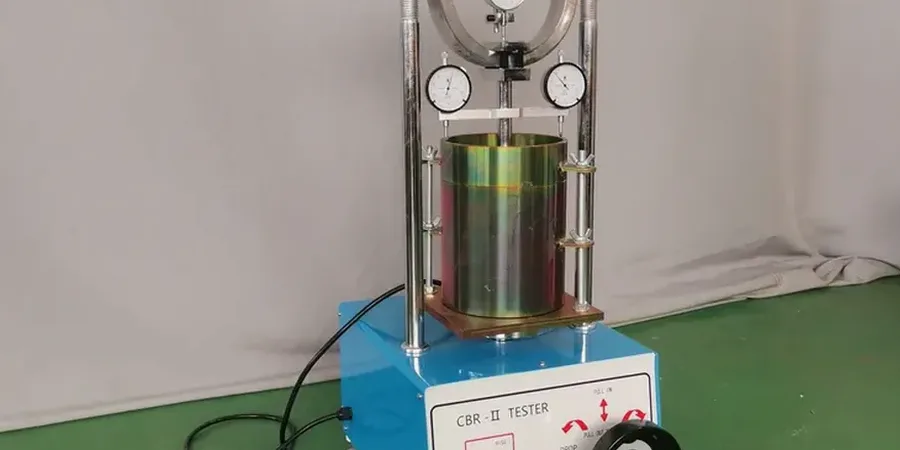
The expansion of the Research Triangle didn't just bring people to Durham—it pushed infrastructure into soils that don't always cooperate. The underlying Triassic Basin geology, with its weathered siltstones and diabase sills, produces subgrades that can look firm in dry weather and turn to jelly after a Carolina summer storm. We've pulled enough cores from failed parking lots in South Durham to know the pattern. A laboratory CBR test cuts through the guesswork. It gives you a direct number—a soaked CBR value—that tells your pavement engineer exactly how much stone, asphalt, or concrete you need to carry the projected traffic load. No fudge factors, no 'we always use 12 inches of ABC.' Just data, backed by ASTM D1883 and AASHTO T 193, from a lab that runs these daily. When we correlate CBR with site-specific grain size distribution and Atterberg limits, the pavement section becomes a precise specification rather than an overbuilt insurance policy.
A soaked CBR value under 5 means every inch of pavement section matters. Above 15, you have a subgrade that works with you.
Process overview
Durham sits on residual soils that don't fit textbook curves. The Iredell series, common around Duke Forest, packs high plasticity and swells when wet. The Appling soils toward RTP drain better but carry micaceous fines that compact in unpredictable ways. A soaked CBR test here isn't optional—it's how you avoid punchout cracks two years after ribbon cutting. We compact samples at optimum moisture from a standard Proctor, then soak them for 96 hours under a surcharge weight mimicking the pavement structure. The loading piston pushes in at 0.05 inches per minute, and we record the stress at 0.1-inch and 0.2-inch penetration. If the 0.2-inch value is higher, we know the sample densified under load rather than sheared—a common signature of partially saturated Piedmont silts. The resulting CBR typically lands between 3 and 8 for untreated subgrades around Durham County, which means lime or cement stabilization is almost always worth evaluating before you price the stone base.
Quick answers
How much does a laboratory CBR test cost in Durham?
A standard soaked CBR test, including the companion Proctor, runs US$120–US$200 per point depending on sample type and turnaround. If you need three points for a moisture-density curve, the package price adjusts accordingly. We quote firm numbers after reviewing your project scope and boring logs.
Why do we need a soaked CBR instead of using the field moisture value?
Durham's subgrade moisture fluctuates seasonally. A sample at field moisture in October might test at CBR 18, but after a wet winter it drops to 4. The 96-hour soak simulates long-term saturated conditions, which is how NCDOT and AASHTO 93 design pavement sections. Designing off an unsoaked number risks underbuilt pavements and premature failure.
How many CBR tests do I need for a commercial parking lot in Durham?
One per distinct soil type encountered in the borings, and at minimum every 2,500 square feet if the subgrade is uniform. For a typical Durham retail pad with two soil units, budget for three to four points—two per unit to bracket the moisture-density curve. Fewer than that and you're extrapolating, which NCDOT reviewers will question.
Can you run CBR on aggregate base course, not just subgrade?
Yes. ASTM D1883 works for any compacted material. We run CBR on graded aggregate base, crusher run, and recycled concrete to verify the structural number of the pavement layers. The sample prep changes—larger mold, modified Proctor effort per ASTM D1557—but the soaking and loading procedure stays the same.
What's the typical turnaround for CBR results?
Five to seven business days from sample delivery to the report in your inbox. The soaking period alone takes four days. Expedited processing is available if you need results for a Monday preconstruction meeting—just flag it when you submit the samples.