← Home · Foundations

Pile Foundation Design in Durham, NC: Deep Foundations for Piedmont Soils

Together, we solve the challenges of tomorrow.

LEARN MORE →

The subsurface conditions between Ninth Street and the Southpoint district tell two completely different stories in Durham. Ninth Street sits on older, more weathered saprolite that can lose strength rapidly when saturated, while areas near Southpoint often hit partially weathered rock within 20 to 30 feet but still carry seams of micaceous silt that complicate bearing calculations. The Piedmont residual soil profile across Durham demands a pile foundation design that accounts for transitions from stiff silty clay to decomposed bedrock within the same boring log. We have analyzed hundreds of SPT profiles from downtown Durham to Brier Creek and consistently find that presumptive bearing values from county soil maps overestimate capacity in the Triassic basin sediments. A site-specific deep foundation analysis backed by SPT drilling data and laboratory classification of the weathered zone is the only way to size piles correctly here: too shallow and you risk differential settlement, too conservative and the owner pays for steel and concrete that the geology does not require.

A pile tip bearing in partially weathered Durham Triassic siltstone can mobilize twice the resistance of the same pile in saprolite; the difference is knowing where that transition occurs on your site.

Methodology and scope

One thing we see repeatedly in Durham is that standard SPT N60 correlations from the FHWA manual overpredict skin friction in micaceous silts unless you apply a reduction factor for mineral grain compressibility. The design process starts with defining the pile type for the site constraints: driven H-piles work well through saprolite but can refuse early on shallow boulders in the Eno River valley, augered cast-in-place piles offer vibration control near historic masonry in the downtown district, and micropiles solve access problems on steep lots near Duke Forest. We develop axial capacity curves using the alpha method for cohesive layers and the beta method for granular decomposition zones, cross-checked against load test data from similar Piedmont formations. Lateral response under seismic loading follows ASCE 7-22 Chapter 12, with p-y curves adjusted for the strain-softening behavior common in Durham's residual soils. When the upper 10 feet show variable fill or organic silt from old mill ponds along Ellerbe Creek, we often pair the pile design with a footings analysis for grade beam support to isolate the slab from ground movement while the piles carry the column loads to competent material.
Pile Foundation Design in Durham, NC: Deep Foundations for Piedmont Soils
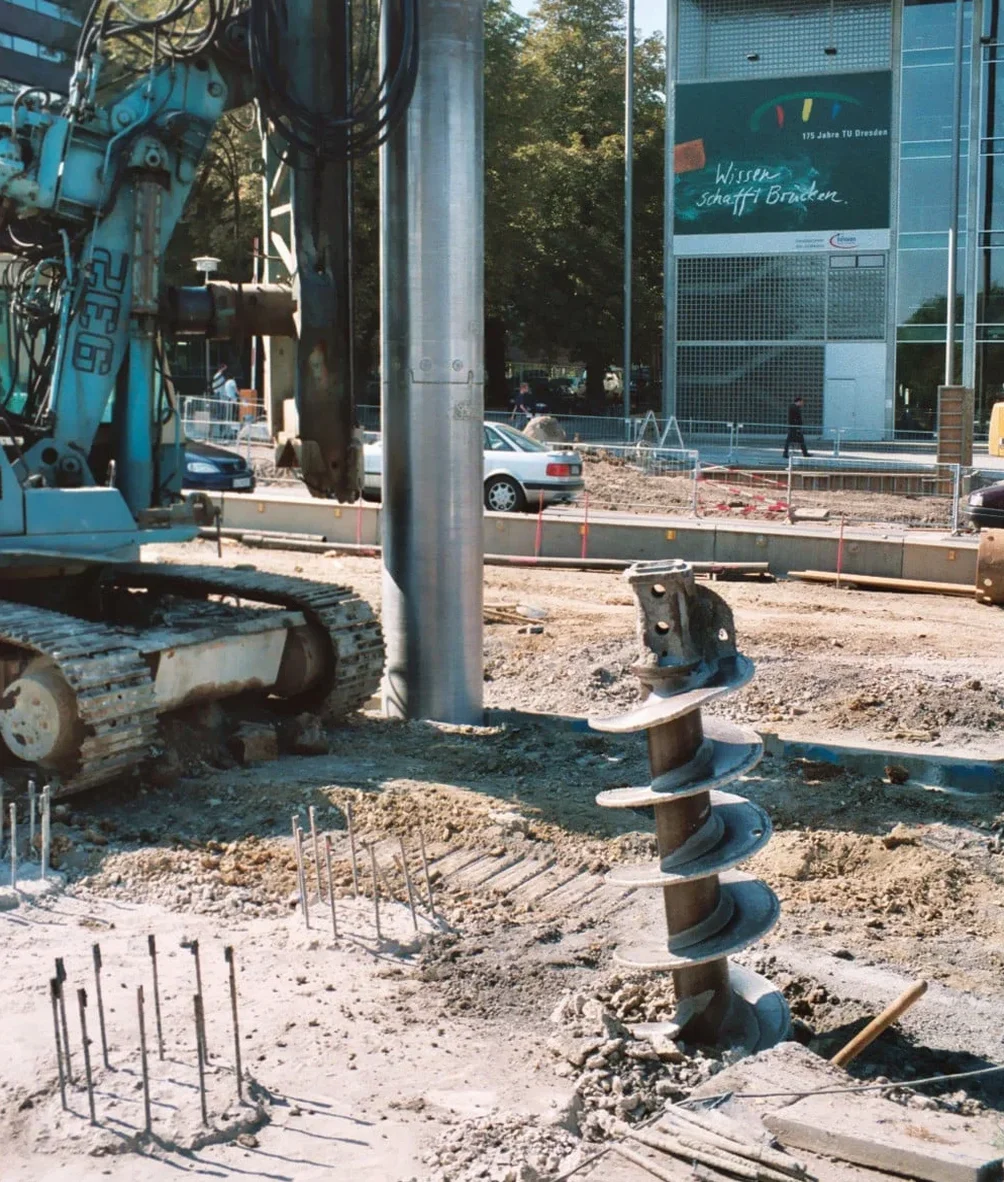
Technical reference image — Durham

Local considerations

Durham straddles a geotechnical boundary between the Triassic sedimentary basin to the east and older metamorphic rocks of the Piedmont to the west, so two sites two miles apart can present entirely different pile installation risks. The Triassic silts and sandstones degrade into a thick saprolite mantle that holds moisture year-round due to Durham's 46 inches of average annual rainfall, and this sustained wetting keeps the upper weathered zone in a state where pile set-up effects are unpredictable without restrike testing. A more serious concern is the presence of graphite schist lenses in the western part of the county: these dark, friable zones can collapse during augering and cause necking in cast-in-place piles if the concrete head is not maintained above the critical level. We have also encountered artesian conditions in deep excavations near Jordan Lake tributaries where groundwater pressures reduce effective stress at the pile tip. A design that ignores any one of these local factors produces a foundation that looks correct on paper but underperforms in the ground.

Need a geotechnical assessment?

Reply within 24h.

Email: contact@geotechnical-engineering.vip

Reference parameters

ParameterTypical value
Design standardIBC 2021, ASCE 7-22 Chapter 12
Axial capacity methodAlpha method (cohesive) / Beta method (granular)
Lateral analysisp-y curves, LPILE or equivalent
Minimum pile embedment10 ft into competent bearing stratum
Typical pile types, DurhamH-piles, ACIP, micropiles, driven concrete
Soil-rock interface verificationSPT refusal + rock coring if required
Settlement criterion (total)≤ 1 inch for isolated pile caps
Seismic site class rangeC to D depending on saprolite depth

Related services

01

Axial Capacity Analysis and Pile Sizing

Static capacity calculations using site-specific SPT data and laboratory shear strength parameters, with pile diameters and lengths optimized for the weathered Piedmont profile. We provide capacity charts for multiple pile types so the contractor can evaluate cost versus performance.

02

Lateral Load and Seismic Response

P-y analysis for lateral deflection under ASCE 7 seismic loads, accounting for the strain-softening of Durham saprolite. We model group effects and pile cap fixity to ensure the foundation system meets drift limits.

03

Construction Monitoring and Load Test Program

Specification of static load test procedures per ASTM D1143, PDA dynamic testing during driving, and restrike protocols to verify capacity gain in saturated Durham silts. We review field data and update the design if subsurface conditions deviate from the geotechnical baseline.

Relevant standards

IBC 2021 Section 1810 (Deep Foundations), ASCE 7-22 Chapter 12 (Seismic Design), ASTM D1586-18 (Standard Penetration Test), ASTM D2487-17 (Soil Classification), AASHTO LRFD Bridge Design 2020

Quick answers

What is the typical cost range for a pile foundation design in Durham?

For a single-family residential or light commercial project in the Durham area, the pile foundation design phase typically ranges from US$1,670 to US$6,070 depending on the number of piles, the complexity of the soil profile, and whether lateral load analysis is required. This includes the geotechnical report with axial capacity curves and construction specifications.

How deep do piles generally need to go in Durham's Piedmont soils?

It varies by location within Durham. In the Triassic basin east of downtown, competent bearing material often lies between 25 and 40 feet where partially weathered siltstone is encountered. In western Durham near the Eno River, piles may reach 50 feet or more to get through bouldery colluvium and into sound rock. We determine the target depth from SPT N-values exceeding 50 blows per foot sustained over at least 10 feet of penetration.

Do Durham building codes require pile load testing?

The IBC 2021, adopted by the City of Durham, requires load testing when the design capacity exceeds 30 tons per pile or when site conditions are considered variable. For larger commercial projects, at least one static load test per pile type is typically specified, supplemented by PDA dynamic testing on production piles to confirm capacity.

Can you design piles for steep lots with limited equipment access?

Yes, we frequently specify micropiles or small-diameter drilled piles for Durham hillside lots where a full-size drilling rig cannot operate. These systems use modular equipment that can be staged on a narrow access path, and the design accounts for the lateral earth pressures from the slope itself.
Location and service area

We serve projects across Durham and surrounding areas.

View larger map