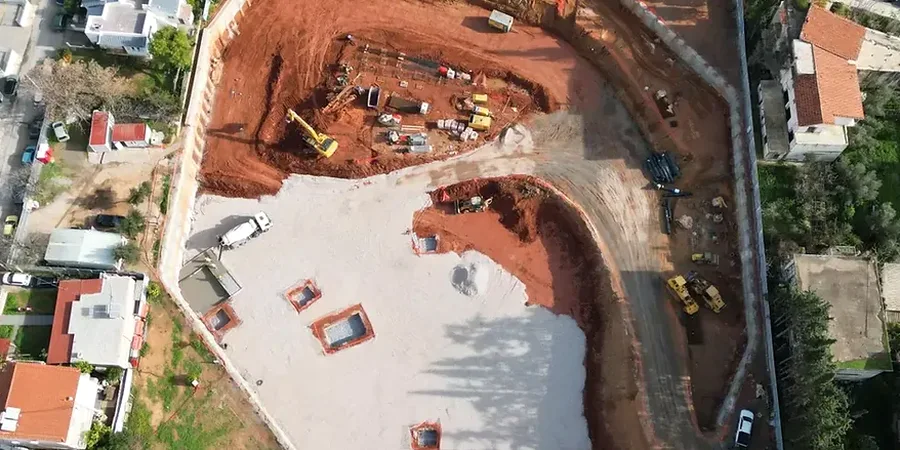
The contrast between downtown Durham’s heavy I-85 corridor infrastructure and the rolling topography near Duke Forest reveals exactly why deep excavation design here demands more than textbook solutions. In the central business district, we encounter partially weathered diabase sills that hold near-vertical cuts temporarily, then degrade when exposed to summer humidity. Out toward the Eno River, the saprolite transition from rock to soil happens across just a few feet, creating mixed-face conditions that complicate soldier pile and lagging performance. Our team has worked both extremes on the same project—Tenth Street parking structures are a prime example—and we rely on CPT testing to map refusal depth continuously, then layer in triaxial strength data for the intact rock where SPT blows exceed refusal. This dual approach prevents the over-design trap that costs Durham developers real money on shoring.
Saprolite in Durham loses significant strength upon exposure. A two-week open excavation can experience a 30 percent reduction in stand-up time if not properly protected.
Local context
At 404 feet above sea level, Durham sits squarely on the Piedmont plateau, where the depth to bedrock varies more than most engineers expect—from less than 10 feet near the Durham Freeway to over 80 feet in alluvial pockets along Third Fork Creek. The real risk in this city is not deep-seated failure but the transitional zone: partially weathered rock that looks competent in an auger cutting but slakes within hours of air exposure. We have seen excavations where a perfectly stable vertical face in saprolite turned into a raveling hazard after a single overnight rain, simply because the designer assumed rock parameters for a material that behaves like soil once the suction is lost. Downstream consequences include settlement of adjacent roadways like Duke Street or Chapel Hill Road, damage to shallow utilities, and costly stop-work orders. Our approach includes mandatory facing protection within 24 hours of cutting and groundwater cutoff where the water table sits within five feet of the excavation bottom.
Relevant standards
IBC 2021 Chapter 18 (Soils and Foundations) with Durham County amendments, ASCE 7-22 Minimum Design Loads, Section 3.2 Earth Pressures, FHWA Geotechnical Engineering Circular No. 4 (GEC 4) – Ground Anchors and Anchored Systems, ASTM D1586-18 Standard Test Method for SPT and Split-Barrel Sampling of Soils, AASHTO LRFD Bridge Design Specifications, 9th Edition (earth retaining structures)
Quick answers
What is the typical cost range for geotechnical design of a deep excavation in Durham?
For most projects in Durham, the geotechnical design package—including subsurface characterization, shoring analysis, dewatering design, and construction monitoring plans—falls between US$2,140 and US$7,180. The final figure depends on excavation depth, proximity to adjacent structures, and the complexity of the groundwater regime at the site.
How does Durham’s saprolite affect deep excavation design?
Saprolite is a transitional material between soil and rock, formed by in-place weathering of the underlying bedrock. In Durham, it often retains the texture of the parent rock but has lost much of its cementation. This means it can stand vertically when freshly cut but deteriorates quickly when exposed to air and moisture. Our designs include facing protection within 24 hours and conservative strength parameters that reflect the material’s sensitivity to wet-dry cycles.
What shoring system works best in Durham’s Piedmont geology?
There is no single answer for all of Durham. Soldier pile and lagging with tieback anchors performs well where rock is within 20 feet of the surface. In deeper saprolite profiles, secant pile walls provide better groundwater cutoff. Near historic masonry in the downtown core, we often specify internal bracing to minimize lateral movement transferred to adjacent foundations.
How long does the design and permitting process take for a deep excavation in Durham County?
A typical design timeline runs four to six weeks from completion of the subsurface investigation to submission of signed and sealed drawings. Durham County Building Inspections reviews excavation support plans as part of the commercial building permit, and the process can add two to three weeks depending on current workload and project complexity.
Do you handle dewatering permits and discharge compliance in Durham?
Yes. We prepare the hydrogeologic assessment required by the North Carolina Department of Environmental Quality for groundwater discharge, including anticipated flow rates, treatment methods, and receiving water body information. Our designs comply with Durham’s stormwater ordinance and NPDES construction general permit requirements.