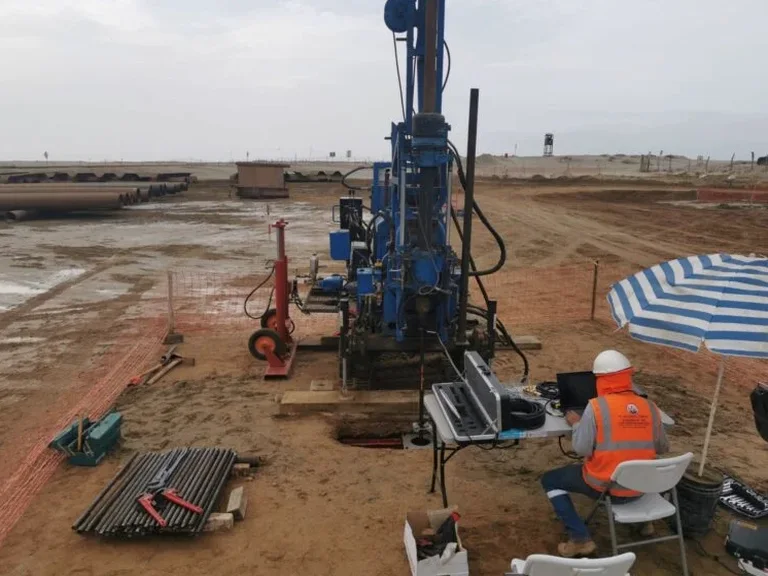
A five-story mixed-use project off Roxboro Street hit refusal at 18 feet during initial SPT borings, right where the Triassic sedimentary rock rises near the surface. The geotechnical engineer switched to cone penetration testing to map the depth to bedrock continuously across the pad. Durham’s subsurface is split between deep saprolite in the western part of the county and shallow diabase sills downtown, so knowing exactly where the refusal plane sits changes footing dimensions and excavation costs. CPT provides that profile without gaps. The cone records tip resistance, sleeve friction, and pore pressure every two centimeters, which means the transition from residual soil to weathered rock shows up as a sharp spike in the qc trace rather than a missed interval between SPT spoon samples. For projects near the Eno River or in the Southpoint area where fill over alluvium is common, combining CPT data with a liquefaction assessment helps determine whether ground improvement is needed before structural loads go in.
Continuous CPT data closes the gap between SPT intervals, particularly where Triassic basin rock rises irregularly across a single building pad.
Process overview
The rig we mobilize in Durham is a 20-ton track-mounted CPT truck with continuous hydraulic push capability. It uses a 15 cm² electronic cone with a 60-degree apex angle, conforming to ASTM D5778. The cone houses three independent sensors: a tip load cell rated to 100 MPa, a sleeve friction sensor, and a piezo element positioned behind the cone shoulder (u2 position) to capture pore water pressure during penetration. Pushing at a constant 2 cm/s, the system logs a full data string every one to two centimeters. In the saprolitic silts common across Durham County, the friction ratio—sleeve friction divided by tip resistance—runs between 1.5% and 4%, classifying the material as silt or silty sand on the Robertson chart. When the cone enters partially weathered diabase, tip resistance jumps above 30 MPa and the friction ratio drops below 1%, giving a clear engineering contact.
Dissipation tests are standard at target depths: we stop the push, hold the cone stationary, and monitor pore pressure decay until 50% dissipation (t50) is reached. In Durham’s Piedmont residuum, t50 values often range from 30 seconds to several minutes depending on silt content, directly informing consolidation behavior without waiting for lab oedometer results. The entire process produces continuous qc, fs, and u2 profiles that support direct design methods for shallow foundations, deep foundations, and liquefaction triggering analysis.
Local context
We have seen projects in Durham where refusal during SPT led the designer to assume rock was uniform across the site, only to find later that the diabase was dipping steeply and the southeast corner of the building was still in residual silt. CPT catches that geometry early. The most common risk in the Piedmont is mistaking a weathered rock zone for competent bedrock: the cone shows a gradual qc increase from 8 to 25 MPa over a meter, not a sharp contact, which means the upper rock is rippable and still compressible under foundation loads. Another issue is pore pressure generation in clayey silts near Jordan Lake, where undrained penetration can produce excess pressures that temporarily reduce effective stress. Running dissipation tests at multiple depths separates drained from partially drained behavior. If contractors skip CPT and rely solely on SPT N-values in transitional ground, the resulting bearing capacity calculations can be off by 30% or more—either too conservative, wasting concrete, or unconservative enough to cause differential settlement in the finished structure.
Relevant standards
ASTM D5778-20: Standard Test Method for Electronic Friction Cone and Piezocone Penetration Testing, Robertson & Cabal (2015) Guide to CPT, 6th Edition, NCEER/NSF Workshop on Evaluation of Liquefaction Resistance (Youd & Idriss 2001), ASCE 7-22, IBC 2021 for seismic site classification via Vs-CPT correlations
Quick answers
At what depth does CPT hit refusal in Durham's Triassic Basin rock?
Refusal depth varies widely by location. In downtown Durham and areas east toward Brier Creek, diabase sills and Triassic sedimentary rock can appear as shallow as 12 to 25 feet. In the western part of the county, saprolite may extend 60 feet or deeper before reaching partially weathered rock. The CPT rig’s 20-ton push capacity generally achieves refusal when tip resistance exceeds approximately 40 to 50 MPa in weathered rock. We monitor the qc trace in real time and stop the push once a sustained increase above 35 MPa is recorded, which typically indicates competent bearing material.
What does cone penetration testing cost for a typical Durham commercial site?
For standard CPTu profiling in the Durham area, pricing ranges from US$190 to US$240 per test location per day, depending on target depth and whether dissipation tests or seismic add-ons are required. A typical commercial lot investigation with four to six CPT soundings to 40-foot depth, including mobilization within Durham County, falls within this range. Deeper pushes beyond 60 feet or sites requiring track-mounted access across steep terrain near the Eno River may incur additional mobilization time.
How does CPT compare to SPT for foundation design in Piedmont residual soils?
CPT provides a continuous record of soil behavior, whereas SPT captures data only at 2.5- to 5-foot intervals. In Durham’s Piedmont residuum, the transition from silt to weathered rock can occur over less than a foot, and SPT can miss it entirely. CPT’s friction ratio and pore pressure data also allow direct soil classification without sample recovery, which is useful in silty soils that tend to wash out during SPT spoon retrieval. Many Durham engineers use CPT for settlement analysis and SPT primarily where rock coring is the next step.