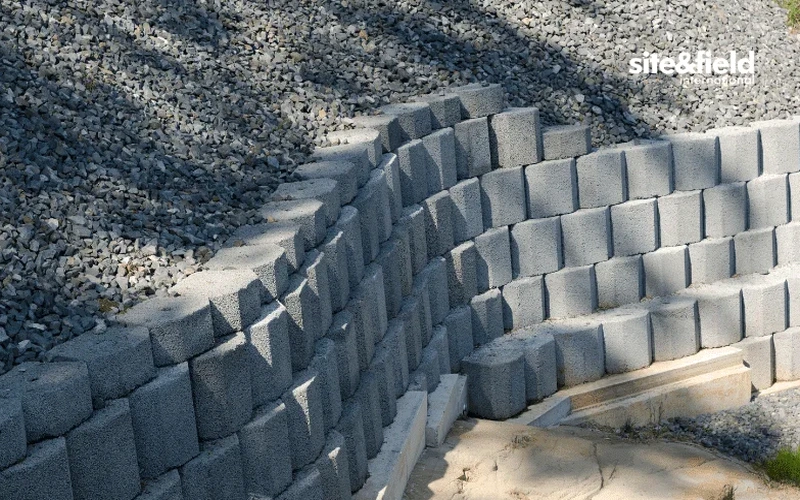
Durham's transformation from a tobacco and textile hub into a center for research and healthcare has driven steady pressure on its hilly terrain. The city sits squarely in the Piedmont physiographic province, where the near-surface geology alternates between silty residual soils and partially weathered phyllite or diabase bedrock. Cutting into these slopes for campus expansions along NC 147 or residential builds near Eno River State Park creates grade changes that demand retaining wall design backed by site-specific investigation. We approach each project by first understanding the saprolite profile: its relic structure, its drainage behavior, and how it transitions from stiff soil to soft rock within the same cut. That transition governs whether a cantilever wall, a gravity structure, or a mechanically stabilized earth system makes sense. For deeper cuts we often combine retaining wall analysis with slope stability modeling to confirm that the global failure surface clears behind the reinforced zone.
A properly drained retaining wall in Piedmont saprolite will outlast the pavement above it. The failures we see are almost always water behind the stem.
Quick answers
What is the typical cost range for retaining wall design on a residential lot in Durham?
For a single-family residential retaining wall in Durham, the engineering design portion typically falls between US$1,090 and US$4,650 depending on wall height, complexity of the subsurface profile, and whether a global stability analysis is required. Taller walls or those adjacent to creeks trigger additional modeling and review time.
At what height does Durham require a building permit and engineered design for a retaining wall?
The City of Durham generally requires a building permit and a sealed design for retaining walls taller than four feet measured from the bottom of the footing to the top of the wall, or for any height wall supporting a surcharge such as a driveway or structure. Walls under four feet with no surcharge may still need a zoning permit depending on location.
How do you handle the transition between weathered rock and residual soil in the wall foundation?
We log the foundation cut carefully because the IBC requires different bearing capacity values for weathered rock versus stiff saprolite. When the cut exposes both materials along the wall alignment, we typically step the footing to bear entirely on the more competent stratum or specify a zone of compacted crusher-run to bridge the transition and reduce differential settlement.
What drainage details do you require behind a retaining wall in Durham's clayey silts?
We require a continuous drainage composite or a twelve-inch-wide column of open-graded stone wrapped in non-woven filter fabric, intercepted at the base by a four-inch or six-inch perforated pipe that daylights at each end of the wall. We also specify a low-permeability cap at the surface to prevent direct infiltration. The native Piedmont silts cannot be used as backfill within the active zone.
Can you design a retaining wall that also functions as part of a basement wall?
Yes, we regularly design basement walls that retain earth on one side. These are treated as restrained walls in our analysis, which changes the load distribution compared to a freestanding cantilever wall. We coordinate the reinforcement with the structural engineer of record to ensure the wall works for both lateral earth pressure and vertical building loads.