Geotechnical Engineering in Durham

Together, we solve the challenges of tomorrow.

LEARN MORE →

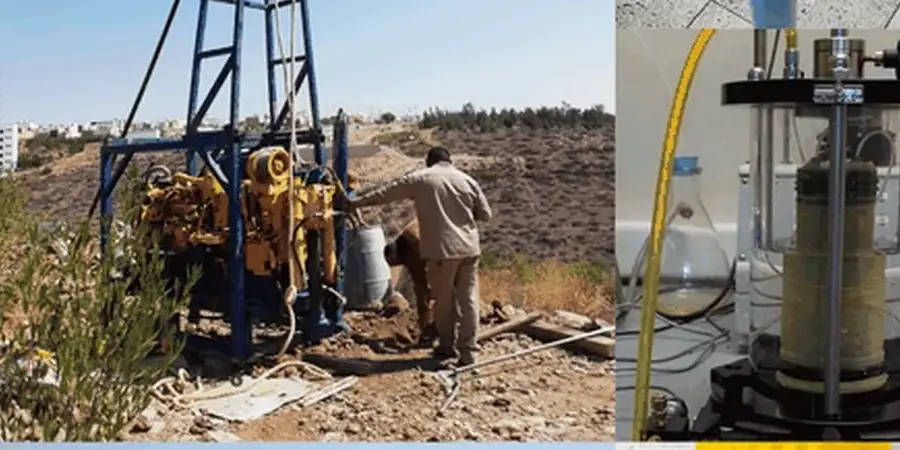
A split-spoon sampler driven by a 140-pound hammer is the first tool on site — SPT refusal at 35 feet is common across Durham’s weathered saprolite. The rig sits on a narrow lot near Duke’s East Campus, collecting Shelby tubes and bulk samples while our lab team runs triaxial and consolidation tests the same day. The Piedmont residual soils here respond differently than transported deposits: strength drops fast when moisture content exceeds the plastic limit. We correlate field N-values with lab-derived friction angles and compressibility to produce a single geotechnical model that feeds directly into the foundation engineer’s design package. A test pit investigation often supplements the boring program where utility conflicts limit drill access.

Weathered Triassic siltstone loses 60 percent of its unconfined compressive strength when exposed to water for 72 hours — timing matters on every excavation in Durham.
Geotechnical Engineering in Durham
Technical reference image — Durham

Methodology and scope

Durham sits squarely on the Triassic sedimentary basin — interbedded siltstones and sandstones weather into silty sands (SM) and low-plasticity clays (CL) that control shallow foundation behavior. The water table fluctuates between 8 and 15 feet below grade depending on the season and proximity to Ellerbe Creek. We routinely run consolidated-undrained triaxial tests (ASTM D4767) on undisturbed specimens to capture the effective stress parameters needed for slope cuts deeper than 12 feet. For pavement subgrades, the CBR values we measure on compacted samples rarely exceed 6 without lime stabilization. The CBR testing for road design protocol we follow aligns with NCDOT standard specifications, which require a minimum soaked CBR of 8 for flexible pavement sections. Grain-size curves typically show 30 to 50 percent fines, which drives the need for Atterberg limits and standard Proctor curves on every project. Consolidation settlement in the basin sediments is moderate — preconsolidation pressures around 2 to 3 tsf are typical at 10-foot depth.

Local considerations

Excavating a basement to 18 feet without recognizing the saprolite contact is the most common mistake we see in Durham. Crews hit what looks like hard rock — weathered siltstone — and assume they can bench vertically. Two days later a 12-foot slab peels off the face after a summer thunderstorm saturates the relic joints. The IBC classifies the site as Site Class C or D depending on shear-wave velocity, and ASCE 7 seismic coefficients for Durham are moderate but not zero — a 0.15g short-period spectral acceleration still amplifies through soft clay lenses. We run undrained strength profiles and short-term stability checks before any cut exceeds 8 feet. A retaining wall without drainage gravel behind it fails here inside five years. The Triassic basin doesn’t forgive shortcuts.

Need a geotechnical assessment?

Reply within 24h.

Email: contact@geotechnical-engineering.vip

Reference parameters

ParameterTypical value
Predominant soil types (USCS)SM, CL, ML — residual silty sands and low-plasticity clays
SPT N-value range (0–15 ft)4 to 18 blows/foot — weathered zone
Water table depth8–15 ft below grade, seasonal variation
Triaxial effective friction angle (phi')28°–34° for SM, 24°–30° for CL
Undrained shear strength (Su)800–2,200 psf in normally consolidated clay
Soaked CBR range3–6 percent without stabilization
Preconsolidation pressure (Pc)2–3 tsf at 10 ft depth
Shrink-swell potentialLow to moderate — liquid limit typically 25–42

Related services

01

Field Investigation & Sampling

SPT borings with automatic hammer, Shelby tube sampling in clay layers, and bulk sampling per ASTM D420. We log the saprolite contact and measure groundwater during drilling.

02

Laboratory Testing Program

Triaxial CIU and CD tests, one-dimensional consolidation, Atterberg limits, grain-size distribution, and standard Proctor. All tests run in our ISO 17025-accredited lab in Raleigh.

03

Engineering Parameter Report

Effective friction angle, undrained shear strength, compression index, and modulus values ready for shallow and deep foundation design. Includes settlement estimates and bearing capacity recommendations.

Relevant standards

ASTM D4767 — Consolidated Undrained Triaxial Compression Test, ASTM D1586 — Standard Penetration Test (SPT), ASTM D2487 — Unified Soil Classification System, ASTM D698 — Standard Proctor Compaction, ASCE 7-22 — Minimum Design Loads (Site Classification), IBC 2021 — Chapter 18 Soils and Foundations

Quick answers

What soil parameters does the study deliver for foundation design?

The report provides effective friction angle (phi'), undrained shear strength (Su), compression index (Cc), recompression index (Cr), and allowable bearing capacity for shallow footings. For deep foundations we add unit skin friction and end-bearing values by layer.

How long does a soil mechanics study take in Durham?

Field work typically runs 2 to 3 days for a single-family lot. Lab testing adds 7 to 10 business days for triaxial and consolidation — standard Proctor and Atterberg limits are ready in 48 hours. The final report ships 12 to 15 business days after the last sample arrives at the lab.

Do you handle NCDOT pavement subgrade testing?

Yes. We run soaked CBR per AASHTO T-193, standard Proctor per ASTM D698, and grain-size analysis. The report includes a subgrade stabilization recommendation — typically lime or cement — when the soaked CBR falls below the NCDOT minimum of 8.

What does a soil mechanics study cost in Durham?

A complete study with two borings, triaxial, consolidation, Atterberg limits, Proctor, and a signed engineering report runs between US$3,420 and US$4,490 depending on depth and number of samples. We provide a fixed-price proposal after reviewing the site address and structural loads.
Location and service area

We serve projects across Durham and surrounding areas.

View larger map