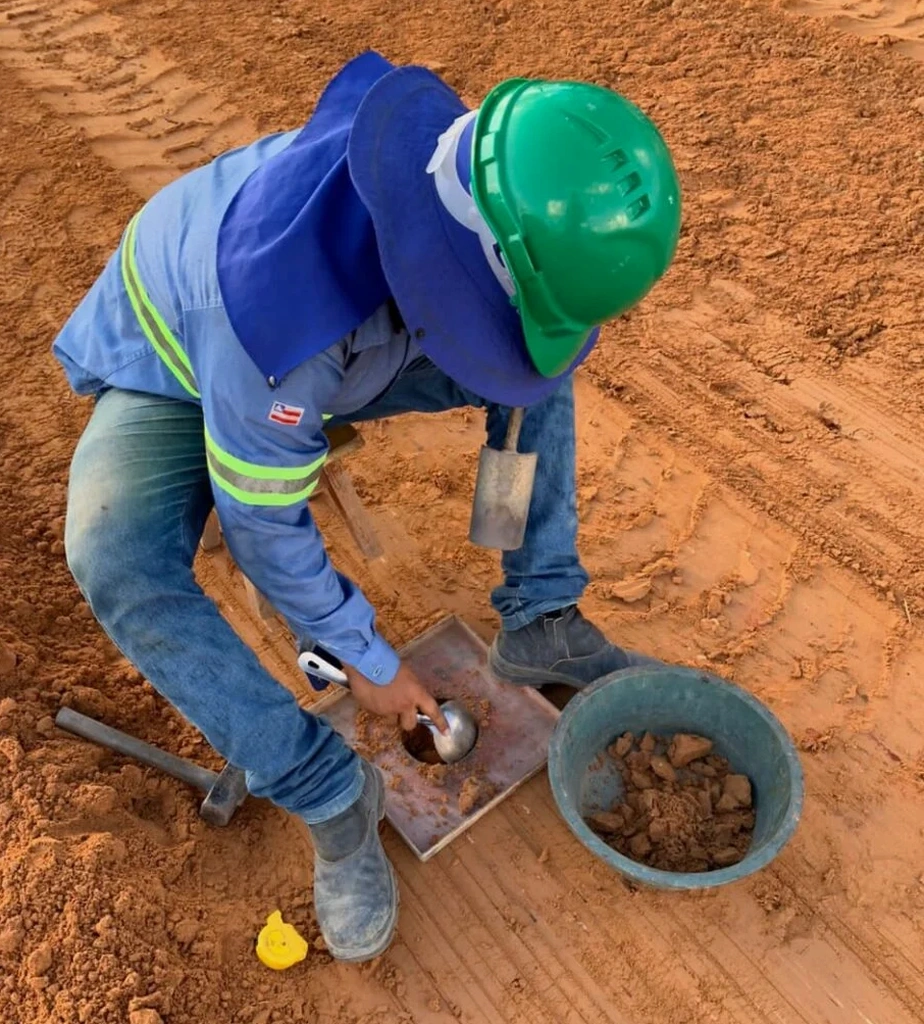
Durham's construction sites sit on the weathered profile of the Carolina Piedmont, where saprolitic silts and micaceous sands transition abruptly from stiff residual material to completely decomposed rock. This geological setting makes compaction control a non-negotiable step during earthwork, because natural moisture retention in the local Cecil and Appling soil series can mask under-compacted zones that would consolidate unevenly under structural loads. The field density test using the sand cone method, performed in accordance with ASTM D1556, provides a direct measurement of in-place dry density and moisture content on lifts that rarely exceed eight inches, allowing the geotechnical engineer to compare the achieved unit weight against the laboratory Proctor maximum for that specific borrow material. Unlike nuclear gauge readings that can drift in the mica-rich fines common across Bull City subdivisions, a carefully executed sand cone test delivers a volumetric determination that holds up under scrutiny from both county inspectors and third-party special inspection agencies. When the fill involves coarse fragments or angular weathered rock typical of deeper cuts near the Eno River, the sand cone method remains the reference standard because the excavated volume is physically measured with calibrated Ottawa sand, not inferred from radiation backscatter. For projects where the structural load demands tighter acceptance limits, the field data often feeds directly into a Proctor tests correlation curve that establishes the target compaction range before the first lift is placed.
A sand cone test on Piedmont residual fill measures compaction directly by physically extracting the entire lift volume, eliminating the mineralogical interference that affects nuclear gauge readings in mica-rich Durham soils.
Process overview
The test apparatus deployed on Durham sites includes a one-gallon threaded jar filled with uniformly graded 20–30 Ottawa sand that has been calibrated for bulk density against the specific container and base plate used on that job, a step that must be repeated whenever the sand source lot changes. The technician excavates a circular hole through the full lift thickness, typically six to eight inches in compacted fill, carefully collecting all removed soil into a sealed bag to prevent moisture loss during the brief interval before weighing on a portable balance readable to one gram. Because Durham's summer humidity can exceed ninety percent by mid-morning, the moisture content determination from the extracted material is run immediately using a field stove or microwave method, since a delay of even thirty minutes can introduce bias into the dry density calculation that would affect the percent compaction ratio reported to the contractor. The volume of the excavation is then measured by inverting the sand jar over the base plate and allowing the calibrated sand to flow freely into the cavity, filling the irregular walls left by hand trimming around partially weathered rock fragments. This physical volume measurement is what distinguishes the sand cone method from nuclear density techniques, and it explains why the North Carolina Department of Transportation continues to specify ASTM D1556 as the referee method for density acceptance on roadway embankments. The entire procedure, from calibration to final calculation, is documented on a field report that includes the test elevation, lift number, station offset, and the time of day, creating a defensible chain of evidence for the engineer’s compaction approval.
Local context
Durham's subsurface profile frequently contains seams of partially decomposed phyllite and schist that degrade into a micaceous silt with low compacted density when worked at the wrong moisture content. Overlooking a single under-compacted lift in a building pad situated on these residual soils can lead to differential settlement that manifests as slab cracking within the first two wet-dry cycles, especially where the fill transitions from cut to fill across a single foundation footprint. The sand cone test mitigates this risk by confirming that each lift meets the specified percent compaction before the next lift is placed, a sequence that makes it impossible to bury an uncompacted layer under subsequent approved lifts. In utility trench backfill along corridors like Roxboro Road, density verification with the sand cone method also prevents the progressive collapse of pavement subgrade around storm drainage lines, a common distress mechanism where trench backfill consolidates under traffic loading after the asphalt overlay is complete. When the test results fall below the required compaction threshold, the engineer can require reworking of the lift with moisture adjustment or additional compactor passes, and a retest must be performed before earthwork continues. This iterative verification process transforms the sand cone test from a simple acceptance checkbox into an active quality control tool that protects the long-term performance of foundations, floor slabs, and pavement sections across the Bull City.
Quick answers
How much does a field density test with the sand cone method cost in Durham?
A single field density test using the sand cone method in the Durham area typically ranges from US$110 to US$170, depending on mobilization distance within the Triangle and the number of tests performed on the same visit. A full-day rate for continuous compaction monitoring with multiple sand cone tests can reduce the per-test cost significantly.
What is the difference between the sand cone method and a nuclear density gauge?
The sand cone method measures soil density by physically excavating the lift and measuring the hole volume with calibrated sand, which makes it insensitive to the mineralogical and moisture interference that can affect nuclear gauge readings in mica-rich Piedmont residual soils. Nuclear gauges are faster, but ASTM D1556 sand cone testing is the referee method specified by NCDOT and many Durham special inspection plans when results are disputed or when coarse fragments are present in the fill.
How many sand cone tests are required per lift on a Durham building pad?
The IBC special inspection requirements generally call for one field density test per 2,500 square feet of each compacted lift, or a minimum frequency established in the project’s geotechnical report. On smaller commercial pads in Durham County, the testing frequency may be adjusted based on the uniformity of the fill material and the observed compactive effort, but no fewer than one test per lift per day is typical.
Can the sand cone method be used in soils with gravel or rock fragments?
ASTM D1556 is suitable for soils with particle sizes up to approximately 1.5 inches, which covers most compacted fill in Durham where weathered rock fragments from the Carolina Piedmont are common. When the test hole encounters a particle that exceeds this size, the test is typically relocated, and the oversized material is documented on the field report to avoid skewing the density calculation.
What happens if a sand cone test fails the compaction requirement?
When a field density test yields a percent compaction below the specified threshold, the affected lift must be reworked, which usually involves scarification, moisture conditioning if necessary, and recompaction with additional passes of the specified roller. A retest is then performed at the same location to verify that the corrected lift meets the project compaction acceptance criteria before the next lift of fill is placed.