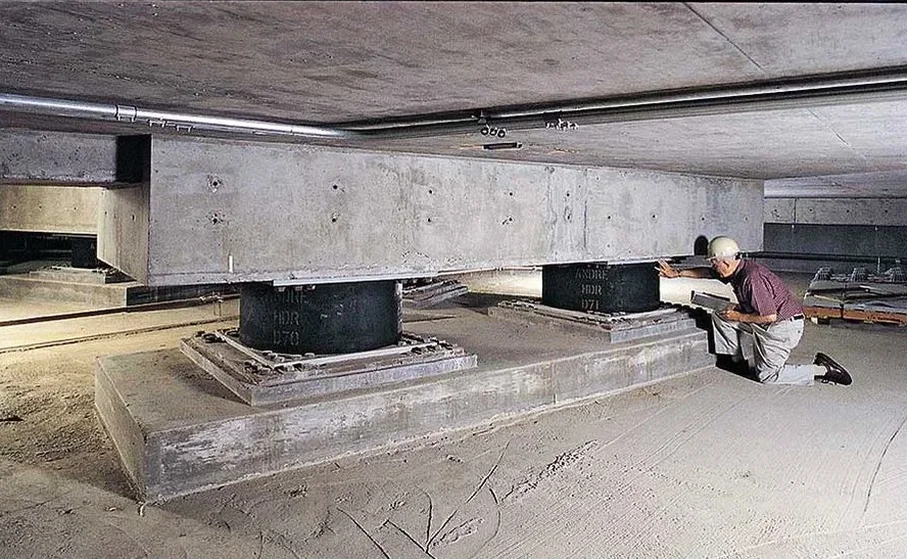
The first time you see an elastomeric isolator up close, it looks deceptively simple. A sandwich of rubber and steel plates. But that compact device, often shipped flat on a truck bed, carries the full weight of a structure and lets the ground move independently underneath it. In Durham we work with lead-rubber bearings and high-damping rubber isolators, sizing them for low-to-moderate seismic demand combined with the Piedmont residual soils that dominate the city. The tricky part here is not peak acceleration. It is soil-structure resonance. When we design isolation systems for buildings near the Eno River or on the deeper saprolite profiles southeast of downtown, we pair the isolator properties directly with shear-wave velocity profiles obtained on site. That link between MASW field data and the nonlinear properties of the bearing is what makes the period shift work. Without it, you are guessing.
A properly tuned isolation system shifts the building period to 2.5-3.0 seconds, where spectral acceleration drops by half or more compared to a fixed-base structure.
Local context
Durham sits at roughly 123 meters above sea level. That elevation reflects the dissected Piedmont plateau. The ground here is old. Really old. But the residual soils, formed from in-place weathering of igneous and metamorphic rock, can lose significant stiffness when saturated. A fixed-base building on these soils amplifies short-period ground motion directly into the structure. We have seen spectral accelerations at 0.2 seconds hit values that surprise owners who assume North Carolina has zero seismic risk. If you skip isolation and rely only on ductile detailing, you accept structural damage as part of the design philosophy. With isolation, the drift concentrates in the bearing, not in the beams and columns. That matters for post-earthquake functionality. In Durham, where hospitals and research labs cannot afford downtime, the cost-benefit equation tilts strongly toward isolation once you run the loss-estimation numbers.
Quick answers
Does a base-isolated building still need a reinforced foundation?
Yes. The isolation system sits between the foundation and the superstructure. The foundation itself must be designed for the forces transmitted through the bearings, including overturning effects and the amplified vertical component if near a source. We typically use mat foundations in Durham's saprolite to provide a rigid base for the isolators.
How much does a base isolation design cost for a mid-rise building in Durham?
The engineering design fee for the isolation system typically falls in the range of US$4,450 to US$7,920, depending on the complexity of the structural framing and the number of ground motion analyses required. Prototype testing of the bearings is a separate cost borne by the manufacturer or owner.
Can you retrofit an existing building with base isolators in Durham?
It is feasible but complex. The building must be temporarily supported while the columns are cut and isolators are inserted. We have done this for historic structures and critical facilities. The biggest challenge in Durham is accessing the column bases when the existing foundation is shallow and the saprolite is partially weathered rock that complicates underpinning.
What happens at the isolation interface during a seismic event?
The bearing displaces laterally while supporting the full gravity load. The lead core in an LRB yields at a defined force, providing hysteretic damping. The displacement is concentrated at the isolation plane. Above it, the superstructure moves almost as a rigid body with minimal interstory drift. That is why contents and non-structural components survive with far less damage than in a fixed-base building.