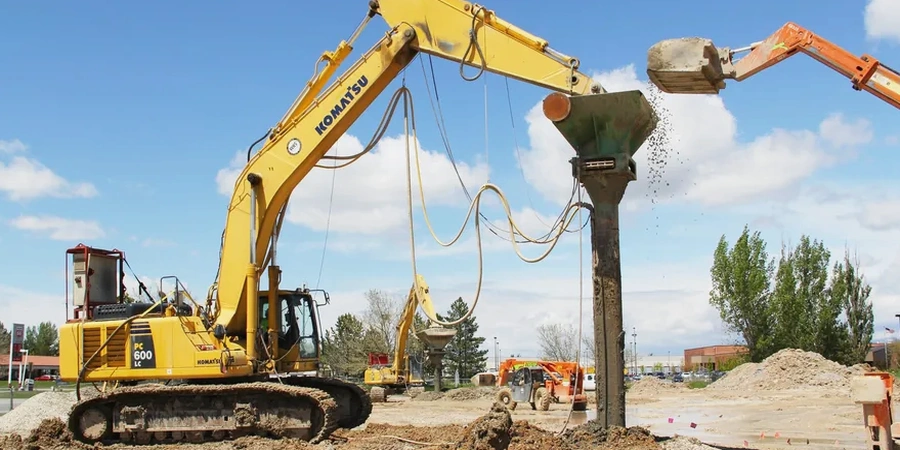
The depth vibrator hangs from a lattice-boom crane on a job site near the Eno River, its cylindrical steel probe penetrating Durham's characteristic sandy silt saprolite at 1,800 rpm. The eccentric weight inside the vibrator generates horizontal centrifugal forces that rearrange soil particles into a denser state, assisted by water jets that fluidize the matrix during withdrawal and repenetration cycles. Durham sits atop the deeply weathered Piedmont geologic province, where residual soils derived from in-place decomposition of granite and gneiss can extend 20 to 60 feet before reaching partially weathered rock. These soils exhibit high void ratios when disturbed during grading operations, creating conditions where differential settlement becomes the primary geotechnical risk for slab-on-grade and shallow foundation performance. Our vibrocompaction design work in the Triangle area focuses on establishing the correct probe spacing, vibration frequency, and treatment depth to achieve a relative density above 70% in loose silty sands that standard fill compaction alone cannot reach.
Achieving 70% relative density in Durham's micaceous silty sands requires vibrator power monitoring and real-time CPT verification — empirical spacing charts alone are not enough.
Local context
Durham's population has grown over 25% since 2010, pushing new construction onto terrain that was historically bypassed due to compressible alluvium along New Hope Creek and its tributaries. The 2020 M5.1 Sparta earthquake, though centered roughly 100 miles northwest, served as a reminder that the Piedmont is not seismically inert — loose saturated silty sands can experience cyclic mobility even at moderate PGA levels. Vibrocompaction design that skips post-treatment verification leaves open the possibility of undetected low-density zones beneath footings or floor slabs, where differential settlement on the order of 1 to 2 inches can shear utility connections and crack masonry veneer. The residual soil profile itself is transitional, grading from stiff overconsolidated crust to softer saprolite within a few vertical feet, meaning that a vibrator set to a single energy level may over-compact the upper zone while leaving the mid-depth layer untreated. We see this pattern re-emerge in forensic investigations where settlement occurs 3 to 5 years after construction, long after the warranty period expires.
Quick answers
How long does a typical vibrocompaction treatment take for a single-family lot in Durham?
For a standard 0.25-acre residential lot in Durham with treatment depths of 15 to 25 feet, the vibrocompaction rig can complete primary and secondary passes in 1 to 2 working days, provided access is clear and the water supply line delivers sufficient pressure at the vibrator jets. Site setup, crane mobilization, and post-treatment CPT verification typically add 2 additional days to the schedule.
What is the cost range for vibrocompaction design and treatment on a Durham commercial pad?
For a commercial building pad under 10,000 square feet in Durham's Piedmont residual soils, the combined design engineering, field treatment, and verification testing typically falls between US$1,580 and US$5,140 depending on treatment depth, grid density, and the number of CPT verification soundings required.
Can vibrocompaction be used in Durham's saprolite soils with more than 20% fines?
Vibrocompaction effectiveness declines as fines content exceeds 20%, because the silt and clay fraction dampens the vibratory energy and prevents particle rearrangement. In Durham formations where fines content reaches 25 to 35%, we often recommend a hybrid approach: vibrocompaction for the sand-dominated layers and stone columns for silt-rich zones, or a full shift to rigid inclusions if the entire profile exceeds the fines threshold.