← Home · Seismic

Soil Liquefaction Analysis in Durham, NC

Together, we solve the challenges of tomorrow.

LEARN MORE →

The soil contrast between downtown Durham near the old Lucky Strike factory and the suburban expansion toward Southpoint is stark. The former sits on partially weathered saprolite derived from the underlying Durham Triassic Basin siltstones, while the latter deals with deeper residual clays and occasional alluvial pockets along the tributaries feeding Jordan Lake. A soil liquefaction analysis in Durham must account for this transition because what behaves like a stiff silty sand at the surface can mask loose saturated lenses at depth, especially in areas where the water table fluctuates within 10 feet of grade. We approach each site by correlating the fines content and plasticity index from the Atterberg limits with the penetration resistance recorded during the field investigation, which immediately tells us whether the material falls into a contractive or dilative behavior envelope under cyclic loading. When the preliminary screening flags a potentially liquefiable layer, we move to the CPT test for a continuous pore pressure and tip resistance profile that eliminates the sample disturbance issues common with split-spoon methods in these transitional Piedmont soils.

Cyclic resistance ratio assessment must integrate site-specific PGA, fines content, and corrected penetration resistance—generic correlations fail in Durham's weathered saprolite transition zones.

Methodology and scope

Durham's position at the fall line between the Piedmont plateau and the coastal plain creates a unique subsurface puzzle. The humidity-driven weathering front extends irregularly, meaning two borings 50 feet apart can encounter completely different degrees of saprolite preservation. A proper liquefaction assessment here does not rely on a single index test. We run the cyclic stress ratio calculation with site-specific peak ground acceleration values pulled from the USGS hazard maps for the 36.00°N, 78.90°W coordinates, then adjust for the magnitude weighting factor prescribed by the NCEER workshop recommendations. The SPT drilling provides the raw N-values we correct for overburden, hammer energy, and rod length before plugging them into the simplified procedure. For the fine-grained fraction, the lab runs a grain size distribution to confirm whether the soil meets the Chinese criteria or the Bray and Sancio susceptibility thresholds, which is critical in Durham where silty sands with 15 to 35 percent fines are common in the floodplains of Ellerbe and Third Fork creeks.
Soil Liquefaction Analysis in Durham, NC
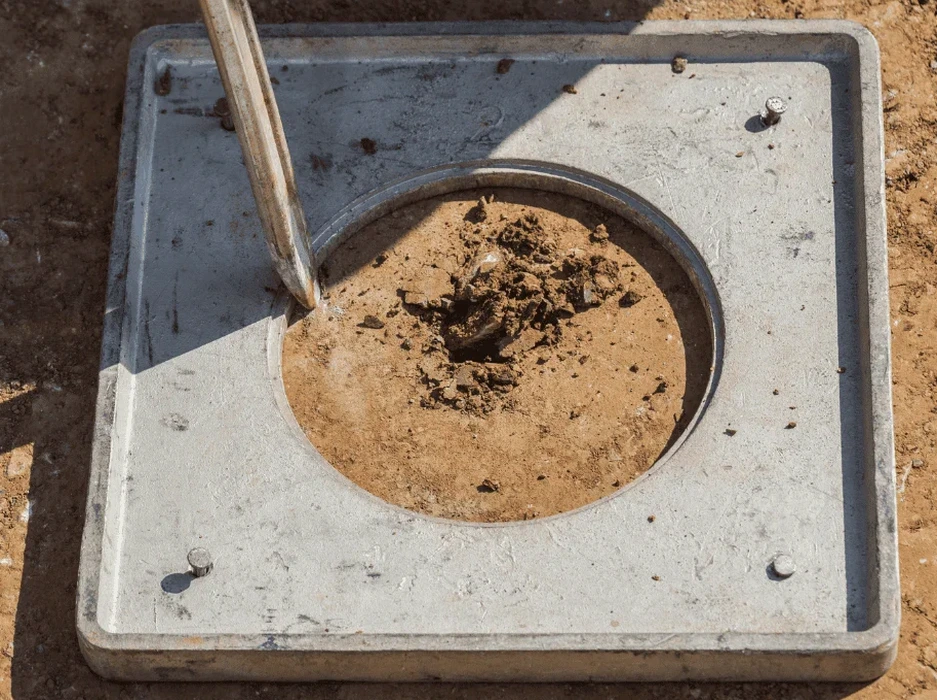
Technical reference image — Durham

Local considerations

The most common mistake we see from contractors in Durham is assuming that saprolite, because it retains the texture of the parent rock, is immune to pore pressure buildup. It is not. Partially weathered siltstone saprolite with a high mica content can develop excess pore pressure under cyclic loading if the drainage path is restricted by an overlying low-permeability clay crust. Another recurring error involves using SPT data without correcting for the automatic hammer energy ratio, which in this region often ranges between 60 and 75 percent—applying the raw blow count overestimates the cyclic resistance and leads to a falsely optimistic factor of safety. The geotechnical team must also consider the effect of the Triassic basin's diabase dikes, which thermally altered the surrounding sediments and created zones of contrasting stiffness that can amplify ground motion differentially across a building footprint.

Need a geotechnical assessment?

Reply within 24h.

Email: contact@geotechnical-engineering.vip

Reference parameters

ParameterTypical value
Peak Ground Acceleration (PGA)Per USGS 2475-year return period, site-specific
Magnitude weighting factorNCEER 1997 / Youd & Idriss 2001 procedure
Standard penetration test (SPT)ASTM D1586-18 with energy correction
Cone penetration test (CPT)ASTM D5778-20, pore pressure dissipation
Fines content thresholdPer Chinese criteria and Bray & Sancio 2006
Shear wave velocity (Vs)Optional, per Andrus & Stokoe methodology
Factor of safety target1.2 to 1.5 per IBC / ASCE 7-22
Post-liquefaction settlementPer Ishihara & Yoshimine 1992 method

Related services

01

Standard Liquefaction Screening

Designed for single-family residential and light commercial construction on lots under one acre. Includes SPT-based liquefaction potential index (LPI) calculation with energy-corrected blow counts, grain size distribution for fines classification, and Atterberg limits on the fine fraction. The deliverable is a signed report with the factor of safety against liquefaction per depth and the estimated ground settlement for the design earthquake.

02

Comprehensive Seismic Site Response

For multi-story structures, critical facilities, and sites with complex stratigraphy near the Eno River floodplain. Combines CPT pore pressure data, shear wave velocity measurements, and laboratory cyclic triaxial testing on undisturbed samples. The analysis includes one-dimensional site response amplification, liquefaction-induced lateral spreading displacement, and bearing capacity degradation under seismic conditions per ASCE 7-22 methodology.

Relevant standards

ASCE 7-22 Chapter 11 and 20 (Seismic Design and Site Classification), ASTM D1586-18 Standard Test Method for Standard Penetration Test (SPT), ASTM D2487-17 Standard Practice for Classification of Soils for Engineering Purposes, IBC 2021 Section 1803 (Geotechnical Investigations), NCEER Workshop Recommendations (Youd & Idriss, 2001)

Quick answers

How much does a soil liquefaction analysis cost in Durham?

The fee for a standard liquefaction screening in the Durham area ranges from US$2,620 to US$3,770. The final cost depends on the number of borings or CPT soundings required, the depth of investigation, and whether laboratory cyclic testing is needed. A proposal with a fixed scope and price is prepared after reviewing the site location and the structural loads.

Which Durham soil types are most susceptible to liquefaction?

Loose, saturated silty sands and low-plasticity silts in the floodplains of Ellerbe Creek, Third Fork Creek, and the Eno River are the primary candidates. The Triassic basin siltstone saprolite is generally non-liquefiable in its intact state, but reworked saprolite and alluvial channel deposits within 15 to 20 feet of the surface can fall into the susceptible gradation range when the water table is high.

What is the difference between SPT-based and CPT-based liquefaction analysis?

The SPT-based method relies on corrected blow counts and requires grain size data from a disturbed sample to evaluate fines content. The CPT-based method provides a continuous profile of tip resistance and sleeve friction, plus pore pressure dissipation data, without sample recovery. The CPT is more repeatable and better suited for detecting thin liquefiable seams, but both methods are valid when correlated through the Robertson or Idriss-Boulanger frameworks and calibrated to Durham's local geology.

Do I need a liquefaction analysis for a single-family home in Durham?

The IBC and ASCE 7 require a liquefaction evaluation for sites assigned to Seismic Design Category D or higher when loose saturated sands are present. Many residential lots in Durham fall into this category, especially near creeks and drainage ways. If the geotechnical investigation identifies potentially liquefiable soils, the analysis is mandatory to confirm that the foundation design meets the factor of safety requirements.
Location and service area

We serve projects across Durham and surrounding areas.

View larger map