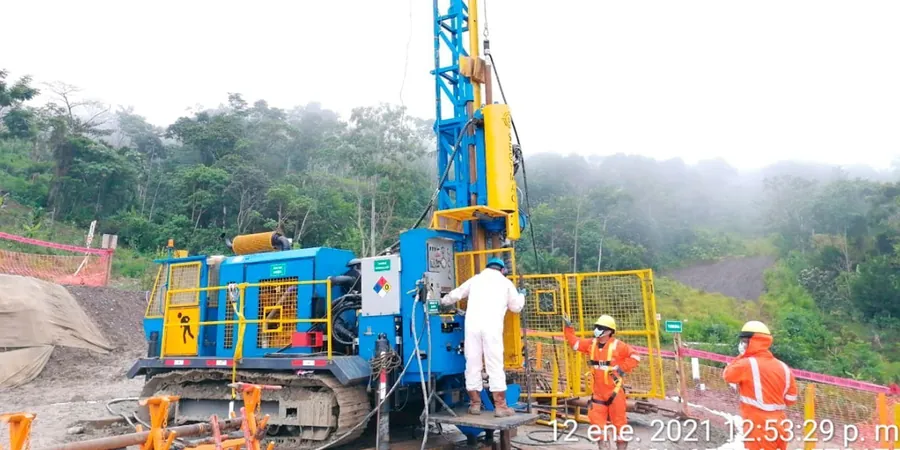
ASCE 7 and the North Carolina Building Code require site-specific soil investigations for all new commercial and multi-family construction, and in Durham the stakes are higher than many engineers initially assume. The city sits squarely on the Triassic Basin and Piedmont residual soil transition, where a thin veneer of silty clay can overlie highly weathered rock at depths of less than ten feet. Our team runs Standard Penetration Tests under ASTM D1586-18 across Durham County, from downtown infill lots to the expanding edges near Research Triangle Park, because the difference between refusal at eighteen inches and refusal at six feet changes the entire foundation strategy. For deeper profiling in mixed alluvial zones near the Eno River, we often pair SPT borings with CPT testing to capture continuous tip resistance and pore pressure data that discrete spoon samples cannot provide.
Auger refusal at three feet in weathered Durham siltstone demands a different foundation than refusal at fifteen feet in alluvial terrace deposits, and only SPT data can map that boundary reliably.
Local context
The geotechnical contrast between downtown Durham and the Eno River floodplain illustrates the risk of skipping a site-specific SPT campaign. In the central business district, compact residual silts and weathered phyllite often yield N-values above 25 below six feet, encouraging a design team to push allowable bearing pressures toward 3,000 psf. Move two miles north toward the river terraces, and the same depth can produce N-values of six or eight in loose alluvial sand with silt seams, where a shallow footing would settle differentially within the first wet season. We have logged borings on the west side of town where angular diabase boulders in a clay matrix gave erratic refusal at two feet, then no refusal at twelve feet just forty yards away. Without an SPT log calibrated to local geology, the structural engineer is designing blind. In Durham, where site variability is driven by ancient rift-basin deposition rather than uniform coastal plain sediments, we routinely run SPT drilling on a tighter grid than the IBC minimum to capture that lateral change.
Quick answers
How much does an SPT boring program cost in Durham?
A typical SPT investigation in Durham, with two borings to depths of 20 to 30 feet and an instrumented hammer for N60 correction, runs between US$550 and US$700 per boring. The total depends on access constraints, rock coring requirements, and traffic control if the site is downtown. We provide a fixed-price proposal after reviewing the project address and planned foundation loads.
How deep do SPT borings need to go for a commercial building in Durham?
The IBC requires borings to extend to a depth where the stress increase from the foundation is less than ten percent of the existing overburden pressure, typically 20 to 40 feet for a mid-rise structure. In Durham, we also drill until competent rock is confirmed by coring when auger refusal occurs above the target depth.
Can SPT data be used to assign a seismic site class in Durham?
Yes, ASCE 7-22 Chapter 20 uses the average N60 over the upper 100 feet to classify the site from A (hard rock) to F (problematic soils). In Durham, most sites fall into Site Class C or D depending on rock depth, and the SPT log provides the primary data for that determination.