← Home · Ground improvement

Stone Column Design in Durham, NC — Geotechnical Ground Improvement

Together, we solve the challenges of tomorrow.

LEARN MORE →

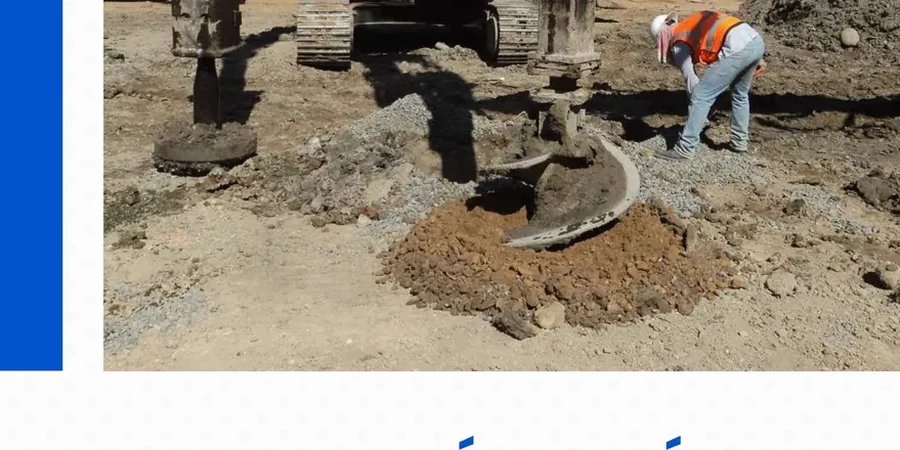
The geology between Ninth Street's ridge and the Eno River bottomlands tells two very different stories under a foundation. Up on the interfluves, you might hit stiff silty clay weathered from diabase sill within six feet — decent bearing, but erratic boulders that wreck auger flights. Down along Ellerbe Creek or Third Fork, the profile shifts to four to twelve feet of soft alluvium over partially weathered rock, and that soft layer is where we see differential settlement eat project contingencies. In our experience across Durham County, stone column design bridges these contrasts better than over-excavation alone. A rig installing graded stone through the mush until it bears on residual soil or pinnacled rock gives you a composite ground mass with predictable modulus, whether you are placing a three-story medical office near Duke Regional or a tilt-up warehouse in Treyburn. Pairing the column grid with a load transfer platform and test pits to map the alluvium-rock interface keeps the design grounded in what the ground actually looks like, not just the boring log.

A stone column is not just a hole filled with rock — it is a designed inclusion whose stiffness and drainage path must match the surrounding Piedmont soil matrix.

Methodology and scope

Last fall we reviewed a five-story mixed-use project off Roxboro Road where the geotech report showed ten feet of loose silty sand at N-values of 5 to 7, sitting right above diabase bedrock at fourteen feet. The structural engineer initially called for drilled piers socketed into rock, but the water table sat at eight feet and the cost of casing through running sand was brutal. We proposed a grid of 24-inch stone columns on six-foot centers, installed by wet top-feed method, with the load transfer platform reinforced by two layers of biaxial geogrid. The key to making it work was the modulus verification — we ran full-scale modulus tests on two trial columns and used the back-calculated E_v to refine the settlement estimate under the 180 psf sustained load. In Durham's residual soil profile, stone column design often benefits from a CPT test push alongside the SPT borings; the continuous tip resistance trace catches thin soft seams that split-spoon sampling can miss, and those seams control the bulging length in the upper portion of the column.
Stone Column Design in Durham, NC — Geotechnical Ground Improvement
Technical reference image — Durham

Local considerations

Durham sits at an elevation band between 250 and 500 feet, straddling the Triassic basin and the Carolina slate belt. The Triassic sedimentary rocks — siltstone and sandstone — weather into a silty clay that looks stiff in a Shelby tube but loses significant strength when remolded during vibratory column installation. If the column construction method is not matched to the soil sensitivity, you can end up with a remolded zone around the column that delays pore pressure dissipation and cuts the short-term composite stiffness by thirty percent or more. We address this by specifying pre-wetting or low-amplitude vibroflot start-up protocols, and by extending the in-situ permeability testing program to capture the horizontal coefficient of consolidation. In the Eno River floodplain, liquefaction of loose silty sand lenses is a real concern, and the stone column grid doubles as a drainage path that limits excess pore pressure buildup during a design earthquake per ASCE 7-22.

Need a geotechnical assessment?

Reply within 24h.

Email: contact@geotechnical-engineering.vip

Reference parameters

ParameterTypical value
Typical column diameter18 to 36 inches
Column spacing (grid pattern)3D to 5D center-to-center
Target aggregate gradationASTM No. 57 stone or equivalent
Design unit friction (f_s) in soft clay0.5 to 1.2 ksf
Allowable bearing pressure (composite ground)3 to 6 ksf for typical Durham alluvium
Post-installation modulus verificationPlate load test (ASTM D1194) or full-scale modulus test
Relevant IBC provisionIBC Chapter 18, Section 1808
Drainage functionRadial consolidation coefficient c_r often 2–5× c_v

Related services

01

Feasibility and Settlement Analysis

We run axisymmetric finite-element models calibrated to SPT and CPT data from your Durham site, estimating total and differential settlement under sustained dead load plus live load for column grids at varying area replacement ratios.

02

Load Transfer Platform Design

The platform bridging the column heads must resist punching shear and distribute stress to the columns. We design the granular layer thickness, geogrid reinforcement, and select fill specification per FHWA guidelines.

03

Modulus Test and QC/QA

We specify and oversee full-scale modulus tests on trial columns, measuring load-deflection response to validate the design modulus. Our inspectors monitor aggregate size, penetration rate, and amperage during production.

04

Liquefaction Mitigation Design

For Durham sites with shallow groundwater and loose sand lenses in the Eno or New Hope Creek corridors, we design stone column grids that function as both reinforcement and drainage elements, limiting r_u to acceptable levels under the MCE event.

Relevant standards

ASTM D1586-18 (Standard Test Method for Standard Penetration Test), IBC 2024 Chapter 18 (Soils and Foundations), ASCE 7-22 (Minimum Design Loads — Seismic), ASTM D2487-17 (Unified Soil Classification System), FHWA-NHI-16-072 (Ground Improvement Methods)

Quick answers

What makes Durham soil tricky for stone column installation?

The transition from Piedmont residual soil to Triassic sedimentary rock often happens within a few feet, and the residual silts can be sensitive — they lose strength when vibrated. We account for this by adjusting the vibroflot start-up sequence and running pre- and post-installation CPTs to confirm the remolded zone has recovered. The diabase sills scattered across the county also create refusal surfaces that need mapping before the column grid is laid out.

How do you verify a stone column design works before building on it?

We run a full-scale modulus test on at least two trial columns at the project site. A reaction frame loads the column head in increments while we measure deflection with dial gauges and telltales. The load-settlement curve gives us the composite modulus of the column-soil system, which we compare against the design assumption. We also push CPT soundings through the column center and midway between columns to check density improvement.

Can stone columns replace deep foundations for a mid-rise in Durham?

In many cases, yes — we have used stone columns under five- and six-story structures on soft alluvium where drilled piers would have needed casing through running sand. The column grid creates a composite ground mass with enough stiffness to keep total settlement under one inch and differential settlement under half an inch. The limiting factor is usually the thickness of the soft layer: beyond about 25 feet of very soft clay, we may look at rigid inclusions or piles instead.

What does stone column design cost for a typical Durham commercial project?

Stone column design fees for a typical Durham commercial project range from US$1,600 to US$4,900, depending on the building footprint, number of column locations, and whether a trial modulus test is included. The design package covers the column grid layout, load transfer platform specification, settlement analysis, and construction QC criteria.

How do stone columns affect the groundwater conditions on a Durham site?

Stone columns act as vertical drains, so they accelerate consolidation of saturated silts and clays. In a Durham site with a water table at six to ten feet, the columns cut the primary consolidation time from months to weeks. The flip side is that you need to manage discharge water during installation, especially if the site drains toward Ellerbe Creek or a tributary with tight sediment limits.
Location and service area

We serve projects across Durham and surrounding areas.

View larger map